资料内容:
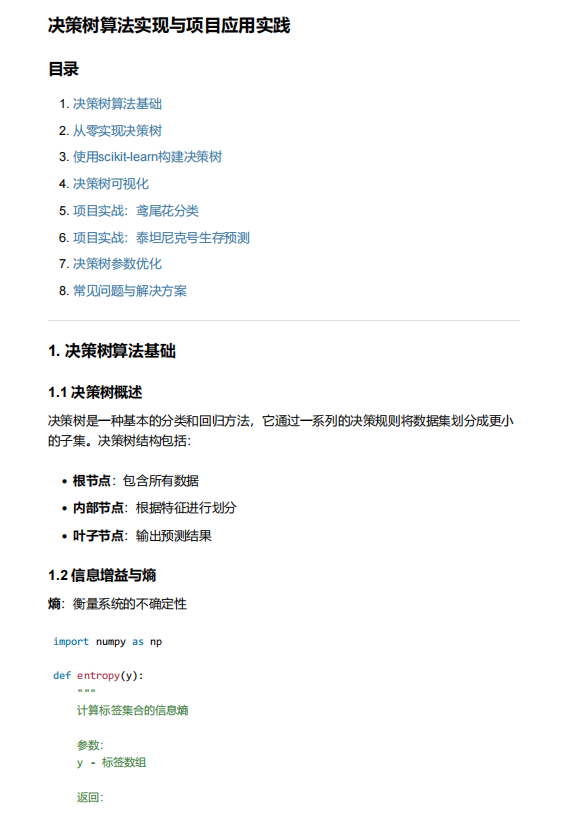
1. 决策树算法基础
1.1 决策树概述
决策树是一种基本的分类和回归方法,它通过一系列的决策规则将数据集划分成更小
的子集。决策树结构包括:
• 根节点:包含所有数据
• 内部节点:根据特征进行划分
• 叶子节点:输出预测结果
1.2 信息增益与熵
熵:衡量系统的不确定性
import numpy as np
def entropy(y):
"""
计算标签集合的信息熵
参数:
y - 标签数组
返回: entropy_value - 熵值
"""
# 获取每个类别的数量
class_counts = np.bincount(y)
# 计算每个类别的概率
probabilities = class_counts / len(y)
# 只考虑非零概率
probabilities = probabilities[probabilities > 0]
# 计算熵
entropy_value = -np.sum(probabilities * np.log2(probabilities))
return entropy_value
# 示例:计算二分类数据的熵
y_binary = np.array([0, 0, 0, 1, 1, 1])
print(f"二分类数据的熵: {entropy(y_binary):.4f}")
y_pure = np.array([0, 0, 0, 0])
print(f"纯数据的熵: {entropy(y_pure):.4f}")
y_uniform = np.array([0, 1, 2, 3])
print(f"均匀分布的熵: {entropy(y_uniform):.4f}")
信息增益:分裂前后熵的差值
def information_gain(X_column, y, threshold):
"""
计算按某特征分裂后的信息增益
参数:
X_column - 特征列
y - 标签数组
threshold - 分裂阈值
返回:
ig - 信息增益值
"""
# 父节点熵
parent_entropy = entropy(y)
# 根据阈值划分左右子集
left_indices = X_column <= threshold
right_indices = X_column > threshold
if len(left_indices) == 0 or len(right_indices) == 0:
return 0
# 左右子集的熵
n_left, n_right = sum(left_indices), sum(right_indices)
n_total = len(y)
e_left, e_right = entropy(y[left_indices]), entropy(y[right_indices])
# 子节点加权熵
child_entropy = (n_left / n_total) * e_left + (n_right / n_total) * e_right
# 信息增益
ig = parent_entropy - child_entropy
return ig
# 示例:计算特征分裂的信息增益
X_feature = np.array([1.2, 2.3, 3.5, 4.1, 5.2])
y_labels = np.array([0, 0, 1, 1, 1])
threshold = 3.0
ig_value = information_gain(X_feature, y_labels, threshold)
print(f"在阈值 {threshold} 处分裂的信息增益: {ig_value:.4f}")